Scientists Found Why GLP-1 Constipation Gets Worse Over Time — and Women Are Quietly Switching From Laxatives to One Celery Gummy
For two years the advice was "drink more water, add fiber, give it time." Now researchers looking further down — at the colony of bacteria that actually runs your colon — are pointing to something no one's medicine cabinet ever reached.
By Karen Ellison · Women's Health Editor·July 2026·5 min read·★★★★★ 4.8/5
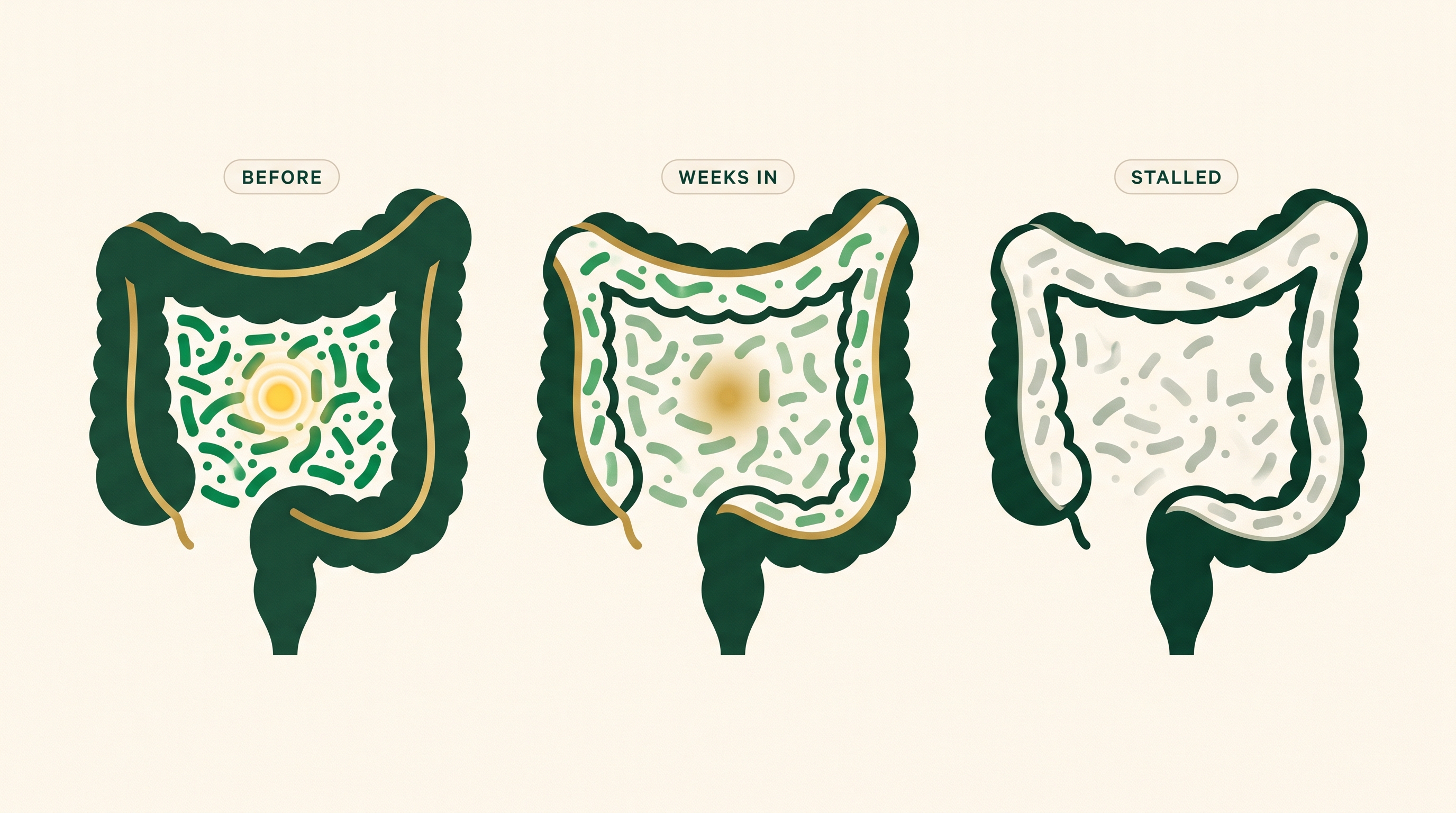
What your bathroom calendar never shows you: the colony of bacteria that makes your colon's signal, quietly thinning week after week — while the scale keeps improving.
What's inside the bottle
Standardized ApigeninSoluble Prebiotic FiberThird-Party TestedNot a Laxative90-Day Guarantee
Millions of women started a GLP-1 medication and got their life back — the weight came off, the food noise went quiet. And then, a few weeks in, a quieter problem started: the constipation that doesn't settle. That gets worse instead of better. That laughs at Miralax, fiber, and every remedy in the drawer.
For a long time the only explanation on offer was "your body is adjusting." It isn't. Researchers looking at what a GLP-1 does further down your gut have landed on a different answer entirely — and it explains, for the first time, why the usual fixes not only fail but sometimes make it worse.
Meet Motilli — a celery-juice gummy built around that answer. It does the one thing the drawer can't: rebuild the starved colony of bacteria that makes your colon's signal, and feed it back, so your colon starts moving on its own again. Adults across the country who've found it keep reordering — and quietly telling their friends. Here are eight reasons why.
"What convinced me was the mechanism. GLP-1 constipation isn't a plumbing problem — it's a starved bacterial colony that's stopped making butyrate, the signal the colon runs on. We built Motilli to do the two things that reverse that: rebuild the environment with a real, standardized dose of apigenin from celery juice, and feed it back with a soluble prebiotic fiber. No bulk fillers, no laxatives, no shortcuts."
Dr. Nadia Vance, PhD · Motilli lead formulator
01Reason
It targets what your laxatives can't — the bacteria that actually move your colon
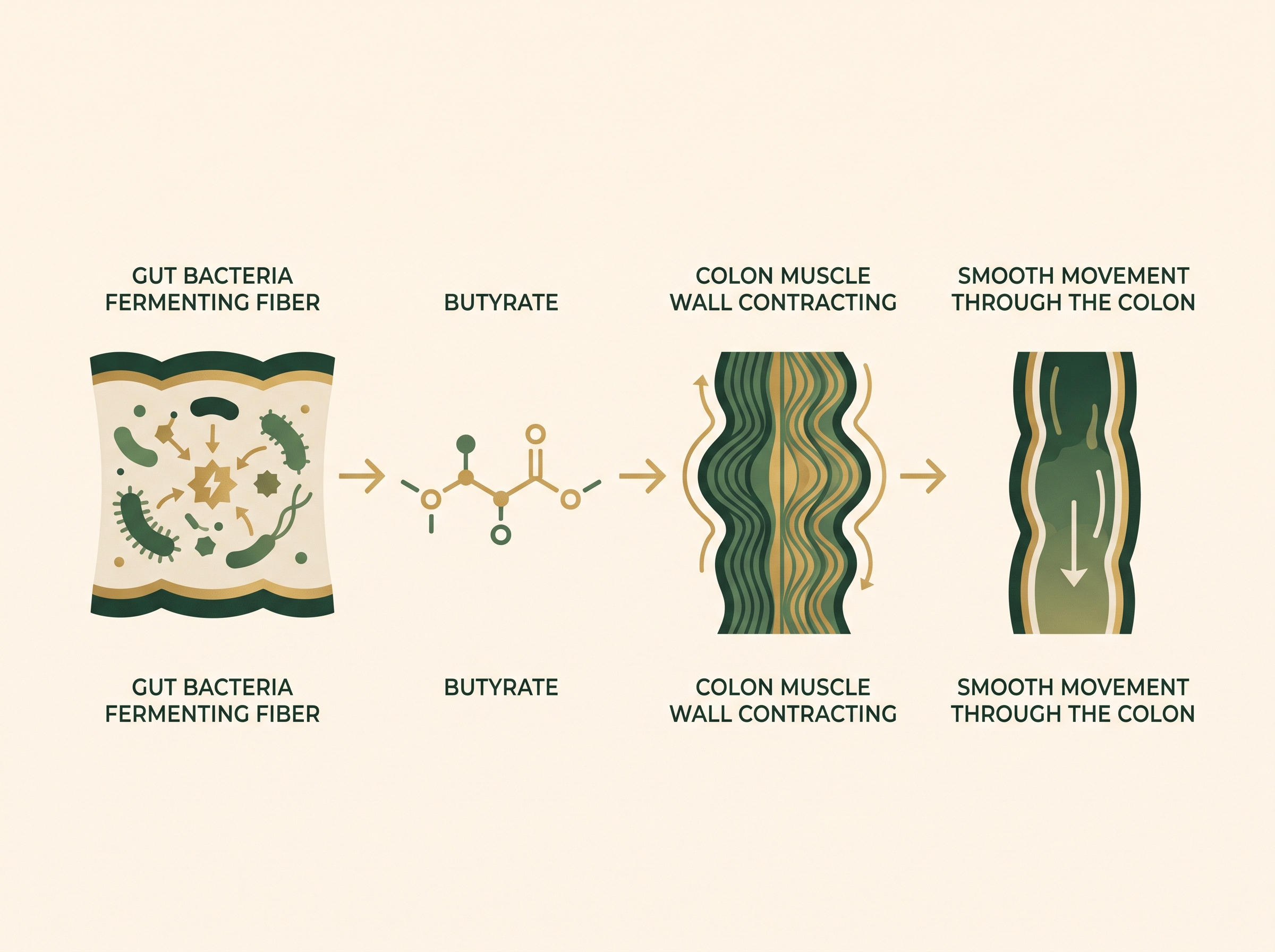
Every product in your cabinet acts on the plumbing. Miralax pulls in water. Fiber adds bulk. A laxative forces one exit. None of them touch the reason the plumbing stopped: your colon is a muscle, and it only contracts when it receives a signal — a short-chain fatty acid called butyrate.
You don't make butyrate yourself. The bacteria in your colon make it by fermenting the fiber that reaches them. That's the step nothing in the drawer addresses — and it's the exact step Motilli was built for.
Your colon runs on a signal called butyrate. Laxatives skip the whole chain and shove the last box — which is why tomorrow you're back where you started.
02Reason
It breaks the loop your medication holds in place — the reason it gets worse, not better
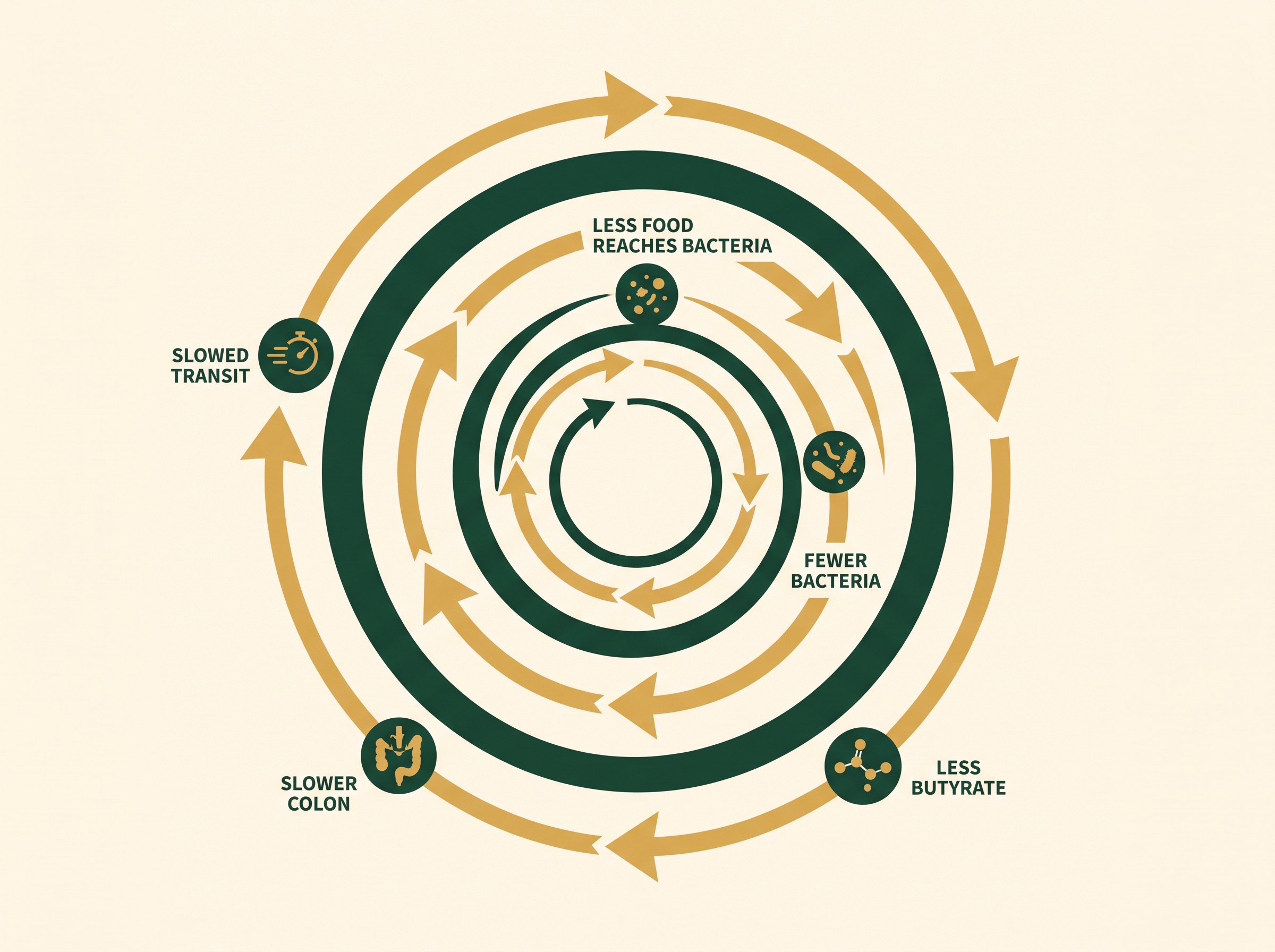
You were told it takes time to adjust. It isn't adjusting — it's a loop that tightens on its own. A GLP-1 slows digestion (that's how it curbs appetite), and that slowdown reaches your colon. Less reaches the bacteria, fewer survive, less butyrate, weaker signal, slower colon — which starves the bacteria even more the next day.
It feeds on itself, a little tighter every week, and the medication holds the first slowdown in place so the loop can't break by itself. You're not failing to adjust. You're stuck in a loop, and only rebuilding the colony breaks it.
This is why waiting makes it worse. Every week the loop pulls tighter — which is also why the sooner you rebuild, the shorter the climb back.
03Reason
It explains why nothing in the drawer worked — and does the thing they all missed
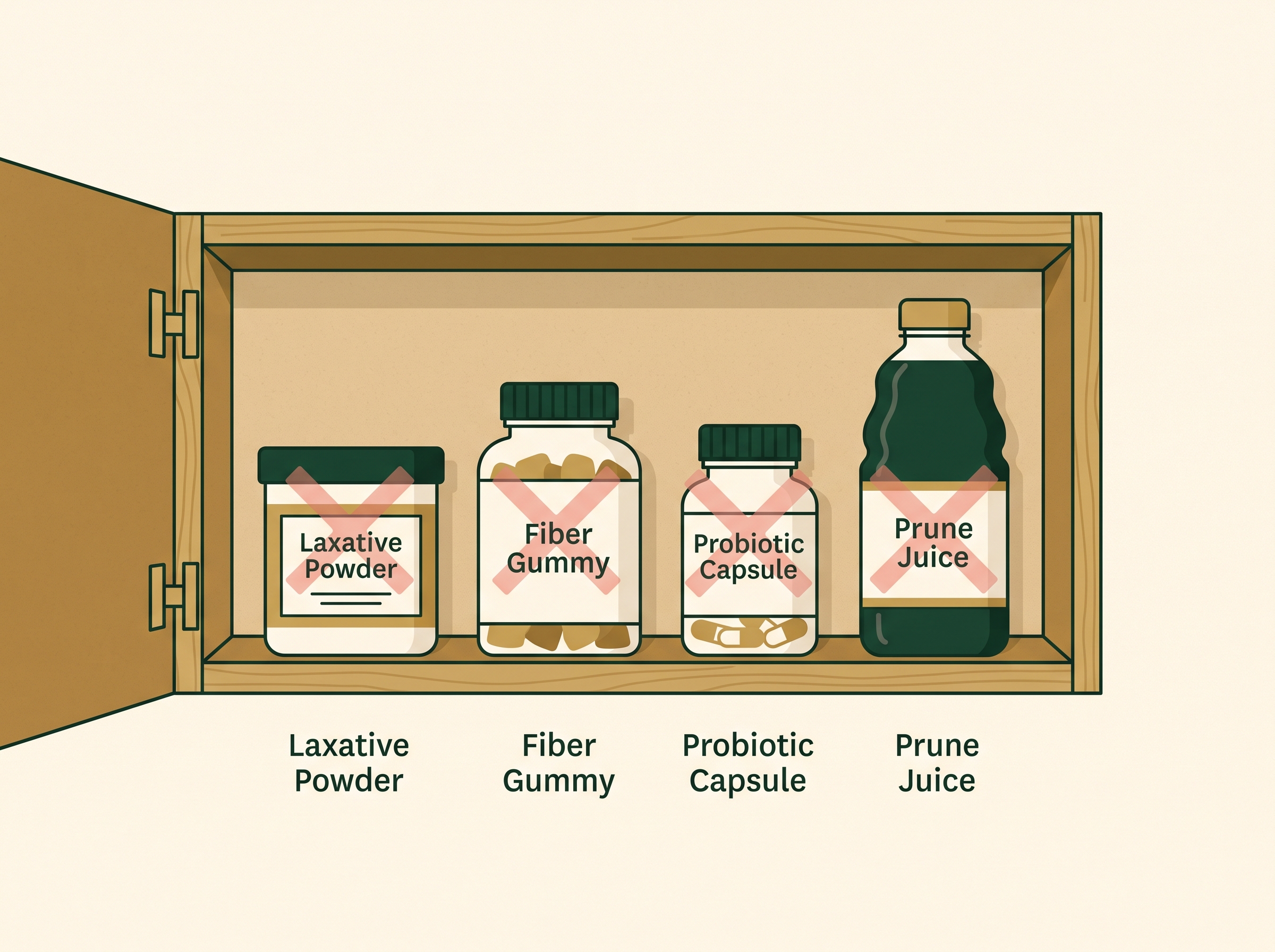
Once you know the colony is starved, every failed remedy makes sense. Fiber is just food for bacteria that aren't there, so it piles up and bloats you. Probiotics drop new bacteria into an environment that can't hold them. Laxatives force one movement and rebuild nothing.
The problem was never that you needed something stronger. It's that you needed something aimed at the bacteria — not the plumbing.
Each one misses the cause. What's actually broken is the bacterial community that makes the signal — and that has to be rebuilt, then fed.
04Reason
It does both halves of the fix — most products do one, or neither
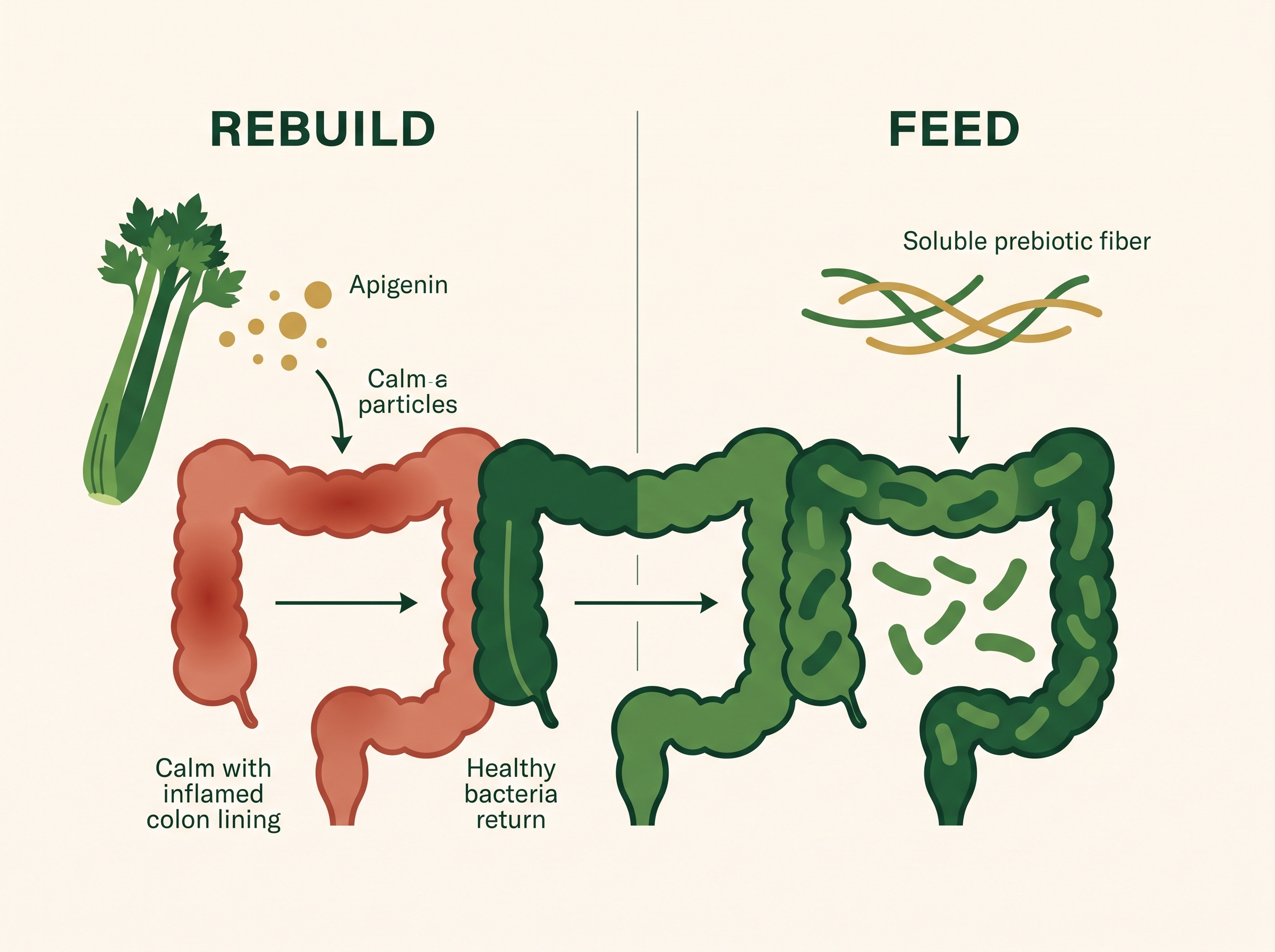
A real fix has to do two things at once. First, rebuild the environment so the right bacteria can survive — that's apigenin, concentrated in celery juice. It calms the inflamed lining, shifts the balance back toward the butyrate-makers, and barely absorbs into your blood, so it stays down in the colon where the work happens.
Then, feed what grows back — a fine, soluble prebiotic fiber that feeds those bacteria specifically, without the coarse bulk that bloats. Rebuild the place, then feed it. Almost everything on the shelf does one half or neither.
Rebuild the environment, then feed the colony — both at once, from one gummy.
Rebuild (apigenin)
Feed (soluble fiber)
Motilli
✓
✓
Fiber tub / gummies
✕
bulk, not soluble
Probiotic capsule
✕
✕
Laxative
✕
✕
Cheap celery powder
trace only
✕
05Reason
It's built on what the research actually shows about the gut
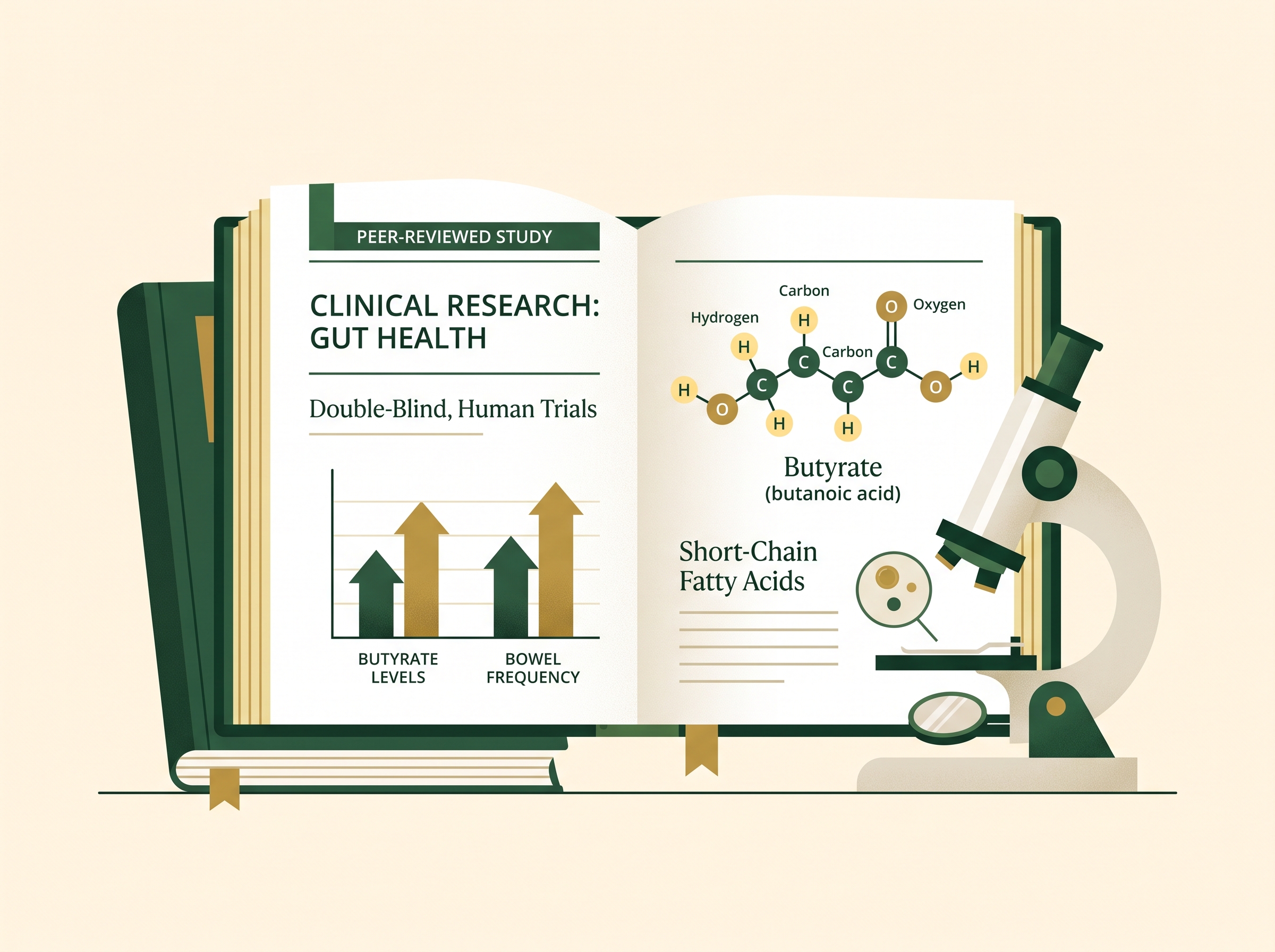
This isn't a hunch. Apigenin has been studied for calming gut-lining inflammation and shifting the microbiome back toward butyrate-producing bacteria. Soluble prebiotic fiber has human trials behind it showing increased butyrate, faster transit, and more frequent movements.
The two together map exactly onto what the loop requires: rebuild the environment, then feed the colony. Motilli was formulated around that pairing rather than around whatever fills a cheaper tub.
The mechanism isn't marketing — it's the same chain gastroenterologists studying GLP-1 transit describe: bacteria, butyrate, signal.
06Reason
It won't touch your weight loss — because the gut and the weight loss are two different systems
This is the one that stops women from quitting. Your weight loss lives in one system — the brain and appetite, where the medication turns down hunger. Your constipation lives in a completely different system — the colon and its bacteria. The slowed transit starves the butyrate-makers as a side effect, not as the medication's purpose.
Because they're separate systems, you can fix the gut without touching the weight loss. Motilli isn't a drug and doesn't act on appetite. It's a gummy — third-party tested, results posted — you take alongside your medication, not instead of it.
You do not have to choose between your body and your gut. That choice was never real — they were never the same system.
07Reason
You'll know if it's working sooner than you'd expect — and here's the honest timeline
It's not a laxative, so the first few days are quiet — that's the rebuild starting, not a failure. For most women the first normal, non-cramping movement lands around day five. From there the gaps get shorter and the bloating comes down over the following weeks.
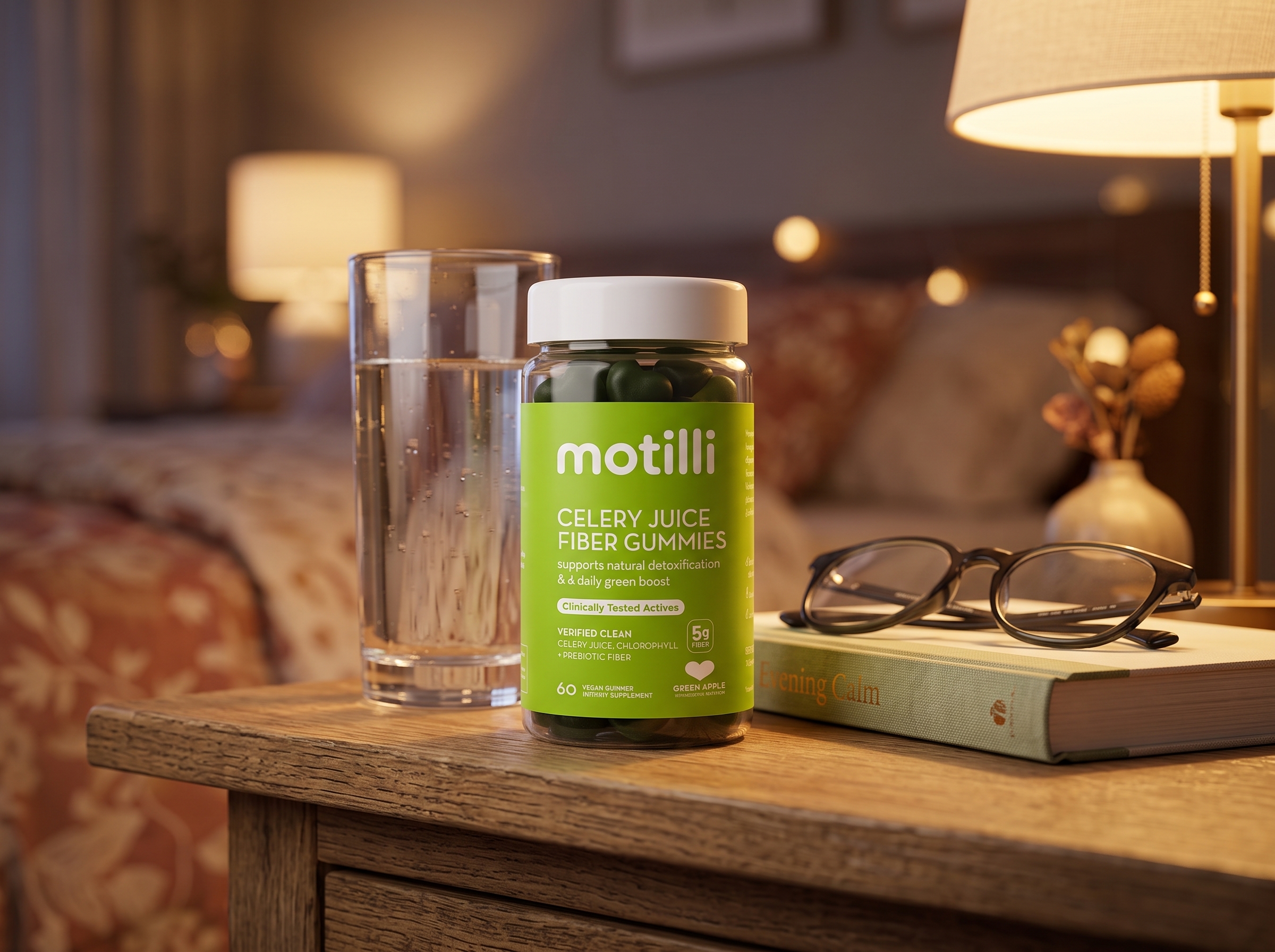
It rewards consistency — a colony starved over months comes back over weeks, not overnight. Three gummies before bed with a full glass of water. That's the whole routine.
Three before bed, with a full glass of water. That's the whole routine — the rest happens while you sleep.
08Reason
Every week you wait, the loop pulls tighter
The colony doesn't pause while you decide. Every week the transit stays slow, there are fewer bacteria and less butyrate — which means the rebuild only gets longer the more you put it off. This is the one side effect that quietly deepens on its own.
The women who wish they'd started sooner all say the same thing: they spent months treating the symptom before anyone told them the cause was fixable. Starting the rebuild before you talk yourself into quitting is the whole point.
The best time to rebuild the colony is before it's starved any further. The second best time is today.
Why it keeps selling out
Made in small, third-party-tested batches
Standardizing celery juice for a real dose of apigenin — not a trace — is slow and expensive, so batches are small and restocks run days behind. When word moves through the GLP-1 groups, it moves fast. If it's in stock with the current offer, that's the moment.
Women across the country are sharing their experience
4.8
★★★★★
Based on 22,400+ verified reviews
5★88%
4★9%
3★2%
2★1%
1★0%
★★★★★✓ Verified BuyerApr 2026
Day five, for the first time in months
"I'd tried Miralax, magnesium, three fiber products. I was ready to quit the shot over it. Day five on Motilli I went normally — and I never had to touch my dose. I almost cried."
Joanna M.
Wegovy · 8 months
👍 312 people found this helpful
★★★★★✓ Verified BuyerMar 2026
My one rule: don't touch my weight loss
"Still down 38 pounds, still losing — and finally regular. My doctor read the mechanism and said keep doing whatever I'm doing."
Patrice T.
Zepbound · 11 months
👍 268 people found this helpful
Individual results may vary. These reflect reported user experiences, not guaranteed outcomes.
🔥 Claim the current offer 🔥
★★★★★ 4.8/5 · based on 22,400+ reviews
Buy 2, Get 1 Free
Free USA shipping · a 60-day rebuild
Apigenin from concentrated celery juice to rebuild the colony, plus a soluble prebiotic fiber to feed it back. Three before bed with a full glass of water. Third-party tested.
⏱ Limited batch remaining · high demand — may sell out
"The bloating was the part nobody warned me about."
I looked pregnant by dinner. Week two on these and I put on jeans I'd written off. Still losing weight. I don't understand why my doctor never mentioned any of this.
❤️👍 341· 52 replies
DS
Diane S.
Ozempic · 9 months
★★★★★
"Day five it just… happened. Normally."
I was five and six days between, no matter what I took. It was quiet for a few days so I almost gave up — then day five. Wish I'd found them four months ago.
❤️👍 288· 39 replies
TR
Tonya R.
Zepbound · 7 months
★★★★★
"I was a week from quitting the medication that changed my life."
The two-systems thing finally made it click — I didn't have to choose. Down 47 pounds and my gut works again. My husband ordered a bottle for his mother.
❤️😮 402· 61 replies
KS
Karen S.
Mounjaro · 5 months
★★★★★
"It was the only one with both."
Skeptical of the small-brand website at first. But it's the only one that had the celery apigenin AND the soluble fiber — everything else was one or the other. That's the whole reason it works.
❤️👍 219· 33 replies
What this article is not
The honest qualifications.
This is an advertorial — paid editorial content produced on behalf of Motilli. The customer reviews, quotes, names, and photographs shown are illustrative, may be lightly edited for length, and reflect individual experiences that are not typical or guaranteed; your results will vary. Photos and portraits may include models, stock, or representative imagery. Read everything here with that commercial relationship in mind.
Motilli is a dietary supplement. It has not been evaluated by the FDA to diagnose, treat, cure, or prevent any disease, and nothing here is medical advice for your situation. Do not stop a prescribed medication — including a GLP-1 — on the strength of an article. If you have severe abdominal pain, vomiting, or can't pass stool or gas, seek medical care immediately. Talk to your own physician. What you do with this information is your decision.
Back in stock · 90-day guarantee
The side effect that gets worse on its own — and the celery gummy built to reverse it
Your laxatives work the plumbing. Motilli rebuilds the starved colony that makes your colon's signal — apigenin from celery juice to rebuild it, soluble fiber to feed it back. Three gummies before bed with a full glass of water. That's the whole routine.
P.S. — Day five. That's the timeline most women describe for the first normal, non-cramping movement. Not overnight, because it isn't a laxative — it's a rebuild. Take three before bed, give it three weeks, and watch the gaps close.
P.P.S. — You do not have to choose between your weight loss and your gut. They run on two different systems. Motilli fixes the second without touching the first — which is exactly why women stop deciding whether to quit.
P.P.P.S. — Motilli sells out, because standardizing celery juice for a real dose of apigenin is slow and small-batch. The colony doesn't wait either — every week the loop pulls a little tighter and the rebuild gets longer. Ninety days, risk-free, no return required. The only real risk is waiting.
Motilli — Buy 2, Get 1 Free90-day money-back guarantee
 By Karen Ellison · Women's Health Editor
·July 2026
·5 min read
·★★★★★ 4.8/5
By Karen Ellison · Women's Health Editor
·July 2026
·5 min read
·★★★★★ 4.8/5